How Many Drives Can Fail in Raid 10
by Brett Daniel, on Apr 22, 2022 3:53:16 PM
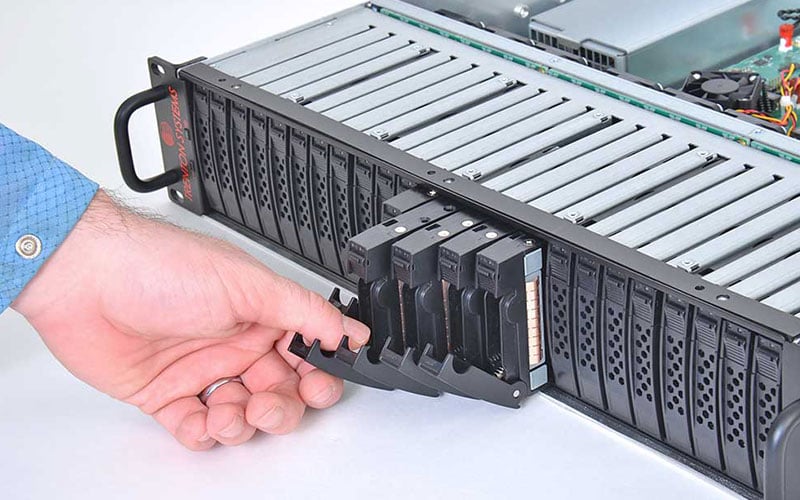
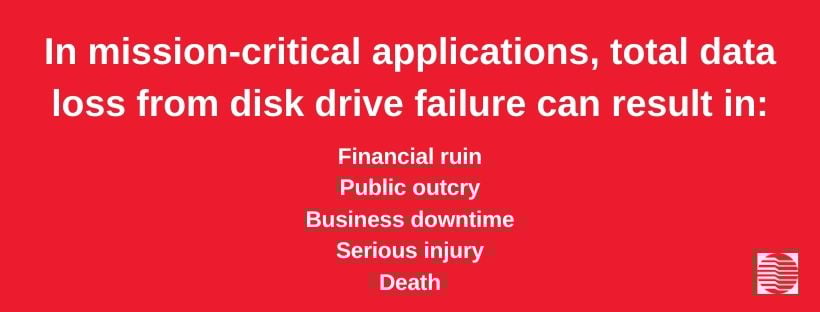
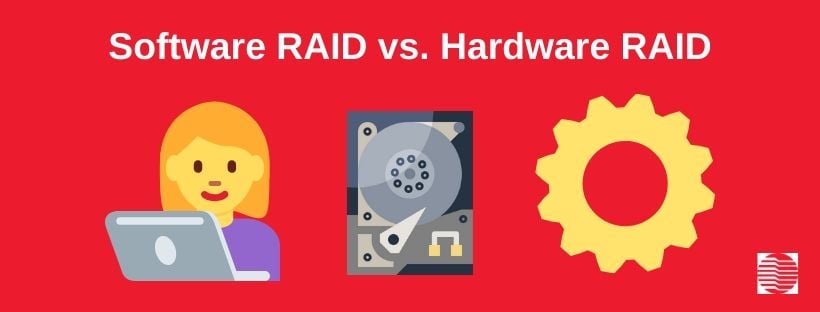
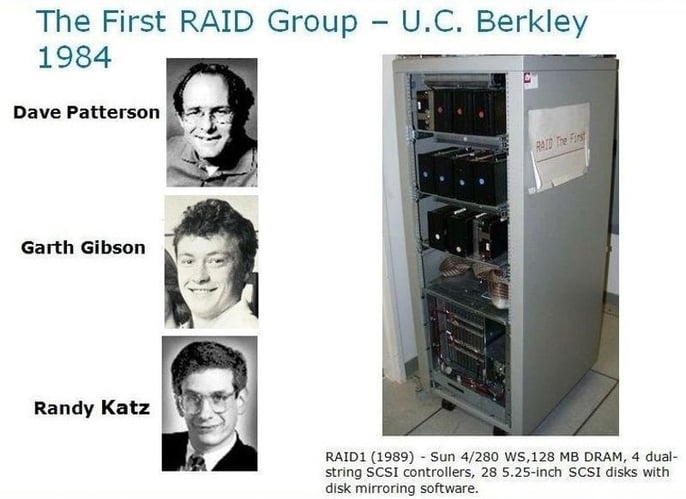
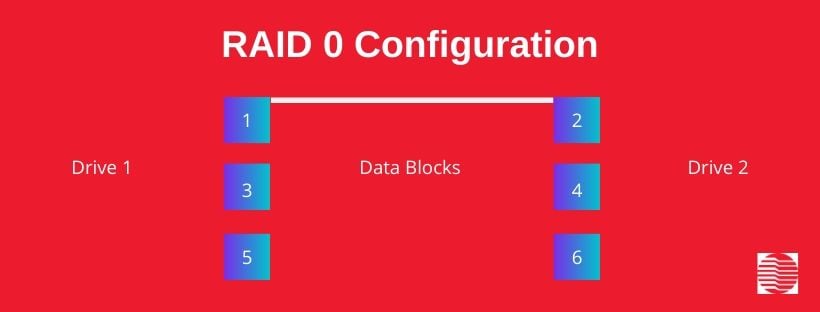
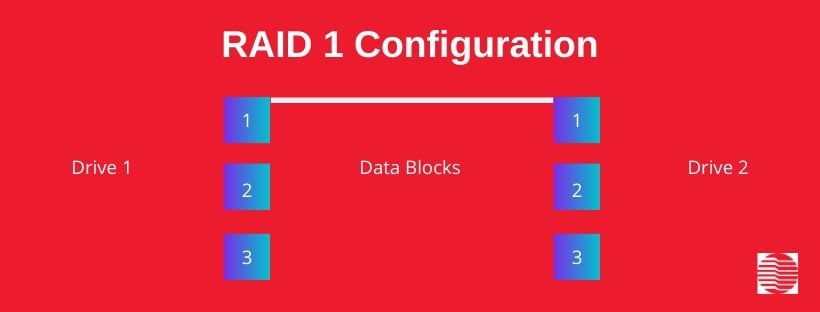
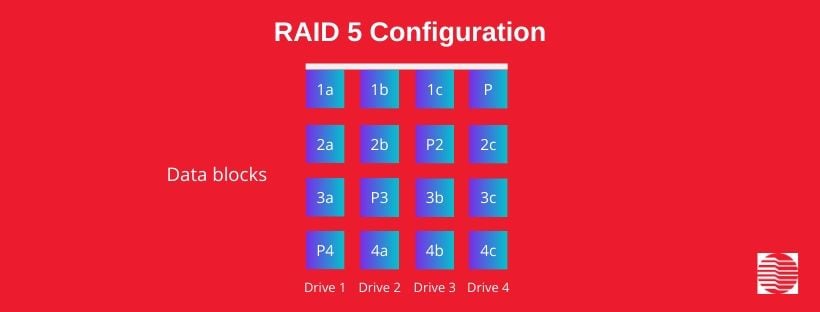
Photo: In that location are a bunch of RAID levels, and then many, in fact, that information technology can be a claiming to distinguish betwixt the differences and benefits of each. In this blog postal service, we'll discuss a few common RAID levels, highlighting both their differences and benefits. Update 05/05/2020 : Check out our blog post on JBOD vs. RAID to learn more about RAID and how it relates to JBOD enclosures. When choosing a RAID level for your storage array, information technology's important to consider what you value nigh: speed, fault tolerance or both. In this web log mail service, we'll review v common RAID levels - RAID 0, RAID i, RAID five, RAID 6 and RAID 10 - as well equally how each level stores data. And if you're interested in a made-in-USA rugged storage system that tin can utilise these RAID types, don't hesitate to drib usa a line to learn more about what we tin do for you lot. We'll also briefly review software RAID vs. hardware RAID, also as the history of the RAID engineering itself. By the end, y'all should be ready to stone 'n RAID. Table of Contents Photo: A Trenton Systems JBOD/JBOF Rugged Storage unit. The 24 NVME SSDs on this unit can be RAID-configured for better functioning and a college degree of fault tolerance. Redundant Array of Independent Disks (RAID) is a storage technology that creates a information loss fail-rubber past merging two or more hard disk drives (HDDs) or solid-land drives (SSDs) into one cohesive storage unit, or array. RAID storage protects against the total loss of a deejay drive's data by repeating or recreating that information and storing it on the additional drive or drives, a procedure also known equally information back-up. Total data loss, which may occur in the event of a deejay drive failure, can devastate businesses and organizations that require frequent access to stored information to carry out their daily responsibilities. Graphic: Consequences of disk drive failure in mission-critical applications Full information loss can be especially devastating for mission-critical applications, whereby a potential failure could result in financial loss, public disapproval, serious injury and fifty-fifty death. Thanks to RAID, mission-critical personnel can continue focusing on executing their essential duties without having to worry almost the potentially dire ramifications of a disk bulldoze failure. Only as you'll see, not all levels of RAID storage protect against data loss. In fact, in that location's only one that doesn't. Configurations that offering information loss protection are referred to as "fault-tolerant." This merely means that the array volition go along to function successfully and provide recoverable data in the event of a disk drive failure. Graphic: Software RAID vs. Hardware RAID. Hard drive icon made past Surang at Flaticon Implementation and management of RAID storage can be executed via software RAID, whereby a commuter on a figurer executes RAID processing, or past hardware RAID, whereby a RAID controller card utilizing a motherboard'south PCI Express slot is used. The effectiveness of software RAID depends on the processing ability of the computer. Information technology's not platonic for complex RAID configurations. For those loftier-performance configurations, y'all'll demand a defended RAID controller, the sole purpose of which is to execute RAID processing. Boilerplate desktop users can get past with software RAID, since nigh operating systems, including Apple tree and Windows, support RAID. Plus, software RAID is the cheaper option. Bigger, more than complex RAID applications, however, will need to go with hardware RAID to achieve the highest possible performance. Graphic: Estimator scientists Dave Patterson, Garth Gibson and Randy Katz. The trio is credited with coining the RAID acronym and sparking commercial interest in the technology. Credit: Reckoner History Museum The acronym "RAID" was coined past University of California, Berkeley estimator scientists David Patterson, Garth Gibson and Randy Katz in their research paper, "A Case for RAID," presented at the 1988 annual conference of the Association for Computing Machinery'due south Special Interest Grouping on Management of Data (SIGMOD). RAID originally stood for "Redundant Assortment of Inexpensive Disks" due to the expense factor of Patterson, Gibson and Katz's newspaper. The trio argued that one array of multiple cheap disks could technically outperform their larger, more expensive counterpart: the mainframe disk drive. Although the concept of combining disk drives to improve performance wasn't a new i, the trio'due south paper sparked commercial involvement in RAID. Several RAID levels have since been standardized by the Storage Networking Industry Clan (SNIA). Configurations are typically evaluated based on their level of fault tolerance, their read and write speeds and their storage capacity. There are many RAID levels in utilise today, several of which are rare. The most common RAID configurations are RAID 0, RAID 1, RAID five, RAID 6 and RAID 10. Graphic: RAID 0 configuration RAID 0, the simplest RAID storage design, utilizes data striping, a process that separates files into segments for storage. The information segments are stored on one disk bulldoze, also as the other disk drives in the array. A RAID 0 setup increases a disk bulldoze's read and write speeds, given that the boosted drives contribute concurrently to the array's overall read/write workload. For instance, if you're storing a 1GB file in a ii-deejay RAID 0 configuration, that 1GB file is separated into two 500MB segments before being written onto each deejay, cutting write time in half. Read time is also cutting in half, since retrieving the two 500MB data chunks from two disks takes less time than retrieving the entire 1GB file from one disk. And then, substantially, the more disks in the RAID 0 assortment, the faster the read and write speeds. Now, why might you desire to use a RAID 0 disk configuration? RAID 0 is not bad for storage applications that require swift read and write speeds and have a relatively low risk of total data loss. It'due south perfect for PC gamers, who mostly prefer shorter save and load times, as well as photographers, videographers and music producers, who frequently save and load large files using editing software. Unfortunately, RAID 0 lacks data back-up, ergo, information technology is non a fault-tolerant assortment. If one of the deejay drives in the array fails, all the data is lost. In other words, RAID 0 should be avoided similar the plague in mission-critical applications, where a full loss of information could have catastrophic consequences. An added plus, all the same, is that RAID 0 users can utilize the entire chapters of the disk drives. So, if yous're using four 1TB disk drives in your RAID 0 array, you have access to 4 TB of space. This is non the case in the other common RAID configurations, where duplicate data chunks are created to ameliorate fault tolerance, and as a consequence, have upwards more space. Graphic: RAID i configuration RAID 1 utilizes disk mirroring, which creates copies of the aforementioned file for storage. In RAID i, the original file is stored on one disk bulldoze, and identical copies of the file are stored on the other disk drives in the array. As a result, RAID 1 produces disk drives that are mirrored copies of each other. Unlike RAID 0, RAID 1 provides data back-up, creating a fault-tolerant array. And then, in a 2-deejay RAID i configuration, if one disk drive fails, the second disk drive contains the same data, ergo, data was not lost and tin can be easily recovered. As a result, fault tolerance has been achieved. Similarly, in a five-disk RAID one configuration, if three disk drives neglect, the fourth and fifth deejay provide users with ii complete backups of the aforementioned data. The more disk drives in the array, the more than copies of the files that are created, and in plow, the greater the degree of fault tolerance. RAID 1 is useful for mission-critical applications, where total loss of vital, sensitive or classified data is unacceptable. Doctor's offices, accounting firms, law firms, banks, constabulary departments, health departments and other government offices could all benefit from a RAID 1 storage configuration. Merely even average, everyday users can do good from RAID 1'due south information cloning abilities. The gamers, the photographers, the videographers and the music producers, each of whom would undoubtedly benefit from the increased read and write speeds of RAID 0, would arguably be ameliorate off sacrificing the speed of RAID 0 for the information redundancy and error tolerance of RAID 1. When deciding betwixt RAID 0 and RAID 1, the RAID 1 users can take comfort in knowing that, in the event of a deejay drive failure, their files accept been safely duplicated. RAID 1 data has non been segmented, so if a disk drive failure occurs, the data do not have to exist pieced back together from the failed deejay and are therefore recoverable. RAID 1 should non replace regular backups, still. Another downside of the classic 2-disk RAID 1 configuration is that its storage capacity is merely half of its total disk drive capacity. So, if you lot're using two 2TB deejay drives, for a total of 4TB of storage capacity, you're technically being allotted 2TB of space considering the 2d drive contains the aforementioned data as the first. At present, if you add a 2TB deejay drive to that same RAID ane array, yous're all the same only being allotted 2TB of space, because at present, the other two 2TB disk drives contain the same data as the start. And in a four-disk RAID 1 array with, for example, 2 2TB disk drives and two 4TB disk drives, for a total of 12 TB of storage capacity, you're nevertheless only beingness allotted 2TB of infinite. Why? Because if y'all're saving 2TB of data to the array, the 2TB drive is filled with the original data, the second 2TB is filled with copies of that data, and the two 4TB drives have been filled with copies at simply half of the drives' usable storage capacity. So, in this setup, you'd have 6TB existence used for data protection and 4TB of unused space. Compare each of these scenarios to a RAID 0 configuration, in which the array's storage capacity would exist equivalent to the total disk bulldoze capacity. The trade-off for RAID 0 is error tolerance, and the trade-off for RAID 1 is speed and efficiency. This RAID stuff tin get rather complex, huh? Well, yous haven't seen anything nonetheless! Be certain to cheque out Synology'southward RAID storage calculator to test out different RAID arrays and storage combinations. Graphic: RAID five configuration RAID 5 is perhaps the most common RAID configuration, and unlike RAID 0 and RAID ane, requires a minimum of iii disk drives to part. RAID 5 utilizes data striping, whereby data are separated into segments and stored onto the split up disk drives in the assortment. Merely RAID five as well utilizes a process called parity, whereby a checksum of all the information is created and stored onto each of the drives in the array too. So, in a four-disk RAID v array, the data and their parity checksums would exist striped and distributed onto all four drives for safekeeping. And in the event of a disk drive failure, the parity checksums allow for the recreation of the stored information. The downside to RAID 5 is that it can only withstand 1 disk drive failure. Thankfully, RAID five is hot-swappable, meaning one disk drive can exist replaced while the others in the array remain fully functional. Unfortunately, if a 2d deejay drive fails while the data from the showtime is existence recreated, then all the data in the assortment are lost. In terms of storage capacity, since the infinite of i disk drive is required to store the parity checksums, total array storage capacity in RAID v configurations is reduced by one whole bulldoze. For example, in a v-disk RAID 5 configuration with five 1TB deejay drives, for a full of 5TB of storage capacity, but 4TB can be utilized since the parity checksums take up the infinite of one whole disk drive. Similarly, in an eight-disk RAID 5 configuration with eight 2TB deejay drives, for a total 16TB of storage capacity, only 14TB can be utilized. RAID 5 outshines RAID 0 and RAID one in terms of fault tolerance and has college total storage capacity than a RAID ane assortment. Like RAID 0, RAID 5 read speeds are fast due the concurrent output contribution of each drive, but unlike RAID 0, the write speeds of RAID 5 suffer due to the redundant creation of the parity checksums. RAID 5 and RAID 6 are not then different. They both employ the data striping and parity processes. The main differences betwixt the two configurations are that RAID 6 requires iv drives to function, and it utilizes double parity, whereby two checksums are created instead of 1. In RAID 6, two disk drives tin can fail without total data loss occurring. This means better security than RAID 5, merely information technology as well ways even slower write speeds since one boosted checksum must be created. Graphic: RAID 10 configuration RAID 10 utilizes both data striping and disk mirroring to achieve information redundancy and thus a high degree of fault tolerance. RAID 10 is sometimes referred to as "RAID i+0," since it combines the mirroring and striping processes found in the RAID i and RAID 0 configurations, respectively. In a RAID 10 configuration, which requires a minimum of 4 disks, data is segmented before beingness duplicated onto the drives in the array. Like in RAID 0, where a file is segmented and stored onto two split deejay drives in a two-disk configuration, in RAID ten, each of those file segments are mirrored, requiring additional storage space. A standard four-disk RAID 10 setup can only withstand 1 drive failure in each mirrored pair of disk drives. Otherwise, total data loss occurs. And as with the standard two-disk RAID one configuration, full storage capacity of RAID 10 is halved. So, six 1TB deejay drives will only net yous 3TB of usable infinite. Indeed, RAID 10 is the best of both RAID 0 and RAID 1, boasting fast read and write speeds and incredible fault tolerance. The all-time RAID configuration for your storage organization will depend on whether you value speed, data redundancy or both. If y'all value speed most of all, choose RAID 0. If you value data redundancy nearly of all, retrieve that the following drive configurations are mistake-tolerant: RAID i, RAID v, RAID half dozen and RAID ten. Make up one's mind your RAID goals by reviewing the following scenarios: Q: Are you a large business concern or system with multiple servers and numerous employees who need consistent admission to the data stored on those servers? A: Choose RAID 5, RAID 6 or RAID x, and go with a hardware RAID controller. Q: Are y'all a small business or organization where speed isn't as much of a priority as proper tape-keeping? A: Choose RAID one or RAID 5, and choose your operating arrangement's software RAID driver. Q: Are you a mission-critical business or arrangement where a loss of sensitive, classified or other vitally of import data could result in headache, financial ruin, serious injury or even decease? A: Choose RAID six or RAID x, and choose a hardware RAID controller. Q: Are yous a gamer, photographer, videographer, music producer or other user who values speed and efficiency over fault tolerance? A: Cull RAID 0 with your operating system's software RAID commuter. But be sure to conduct regular backups. We hope this blog mail service helped clear up the differences between common RAID levels and how each of them tin offer a unique do good to your program or application. Trenton Systems articles customizable rugged storage systems that tin utilize RAID technology. These systems include our JBOF/JBOD and 5U Rugged Storage systems. Not just do nosotros offer RAID-capable rugged storage systems, but we design, manufacture, assemble, integrate and support these systems right here in the United States. That's correct. We do it all in one USA facility to provide you with high-quality rugged computing solutions, cutting down on potential security hazards, support the American economy and American jobs, and offer super fast, in-house client service and support. Trenton Systems creates rugged computer systems to assistance customers around the world meet their rugged computing needs. We stress-test our computer systems to the max, ensuring that customers can behave out industry-specific operations comfortably, effectively and smack dab in the eye of the world's harshest conditions. In other words, we stress so y'all don't have to. 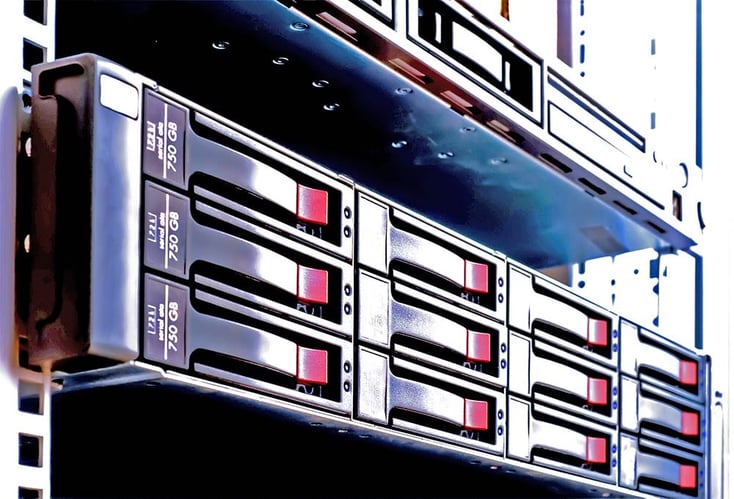

What is RAID storage?
RAID Types: Software RAID vs. Hardware RAID
History of RAID
What is RAID 0?
What is RAID 1?
RAID 0 vs. RAID one
What is RAID 5?
RAID 5 5. RAID 6
.jpg?width=1314&name=Copy%20of%20Copy%20of%20Copy%20of%20Copy%20of%20Announcement%20(1).jpg)
What is RAID 10?
RAID Configurations: Processes and Mistake Tolerance Raid Level Raid 0 Raid 1 Raid 5 Raid six Raid 10 Procedure Data Striping Disk Mirroring Striping + Parity Striping + Double Parity Mirroring + Striping Tolerance Not Mistake-Tolerant Fault-Tolerant Fault-Tolerant Fault-Tolerant Fault-Tolerant
Which RAID is best? Conclusion

Source: https://www.trentonsystems.com/blog/raid-levels-0-1-5-6-10-raid-types
0 Response to "How Many Drives Can Fail in Raid 10"
Post a Comment