Microsoft Access Form Asks Report Parameter Again
To make a query in Admission desktop databases enquire for criteria when you run it, create a parameter query. This allows you to utilise the same query over and over without having to constantly open information technology in Design view to edit the criteria.
Note:This article doesn't utilise to Access web apps.
Understanding the terminology
Earlier getting into the footstep-by-step below, it's helpful to sympathize these terms:
-
Parameter A parameter is a piece of information you lot supply to a query right as you run it. Parameters can be used by themselves or as part of a larger expression to form a criterion in the query. Yous can add together parameters to any of the following types of queries:
-
Select
-
Crosstab
-
Append
-
Make-tabular array
-
Update
-
-
Criteria Criteria are the "filters" yous add together to a query to specify which items are returned when you run the query.
For more data about the types of queries mentioned above, see Introduction to queries.
Create a parameter query
Creating a parameter is similar to calculation a normal criterion to a query:
-
Create a select query, and so open the query in Pattern view.
-
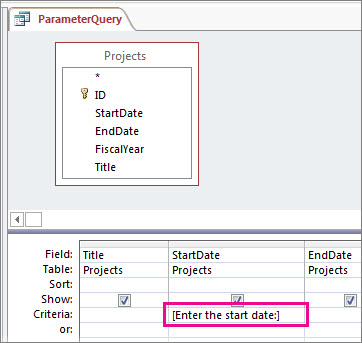
In the Criteria row of the field you want to apply a parameter to, enter the text that you desire to display in the parameter box, enclosed in square brackets. For example, [Enter the start appointment:]
-
Echo step 2 for each field you want to add parameters to.
When y'all run the query, the prompt appears without the square brackets.
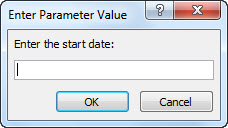
Fill up in the value you're looking for, and so click OK.
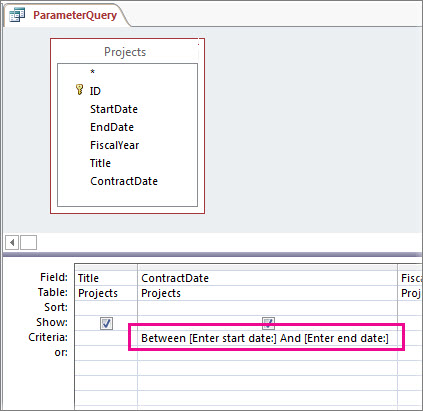
Yous tin can utilize multiple parameters in a criterion. For instance, Between [Enter the outset date:] And [Enter the end date:] will generate two prompts when you run the query.
Specify parameter data types
You can gear up the parameter to accept only a certain type of data. It is specially important to specify the data type for numeric, currency, or date/time data, because then, people will meet a more helpful fault message if they enter the wrong blazon of information, such as inbound text when a currency value is expected.
Notation:If a parameter is configured to accept text data, whatever input is interpreted equally text, and no error message is displayed.
To specify the information blazon for parameters in a query:
-
With the query open in Design view, on the Design tab, in the Show/Hibernate grouping, click Parameters.
-
In the Query Parameters box, in the Parameter column, enter the prompt for each parameter y'all want to specify a information type for. Brand sure that each parameter matches the prompt that you used in the Criteria row of the query design grid.
-
In the Data Blazon column, select the data type for each parameter.
Add together a parameter to a matrimony query
Since yous can't view a union query in the query pattern grid, y'all'll need to do things a little differently:
-
Open the matrimony query in SQL view.
-
Add a WHERE clause that contains the fields you want to add together parameters to.
If a WHERE clause already exists, check to see whether the fields y'all want to add parameters to are already in the clause. If they aren't, add them.
-
Type your parameter prompt into the where clause, for instance, WHERE [StartDate] = [Enter the outset engagement:]
![Two-part union query with the following clause in both parts: WHERE StartDate = [Enter the start date:]](https://support.content.office.net/en-us/media/19e5da7a-bc3a-4c32-87c7-f1d60952a187.jpg)
Note that you lot need to add the same filter to each section of the query. In the picture higher up, the query has two sections (separated by the Matrimony keyword), so the parameter needs to be added twice. When you run the query, however, the prompt just appears once (assuming you have spelled the prompt exactly the same in each section).
For more information about union queries, see Use a union query to view a unified result from multiple queries.
Combine parameters with wildcards for more than flexibility
As with normal criteria, you tin combine parameters with the Like keyword and wildcard characters to match a wider range of items. For example, you might want your query to prompt for a country/region of origin, but to match any value that contains the parameter string. To do this:
-
Create a select query, and then open up the query in Blueprint view.
-
In the Criteria row of the field you lot want to add a parameter to, type Like "*"&[, the text that you want to use as a prompt, and and so ]&"*".
![Query design grid with the following criteria in the CountryRegion column: Like "*" & [Enter country/region:] & "*"](https://support.content.office.net/en-us/media/d06af443-a83a-4fe7-9bd2-07fd908c9338.jpg)
When you run the parameter query, the prompt appears in the dialog box without the square brackets, and without the Like keyword or wildcard characters:
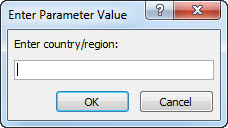
Afterwards you enter the parameter, the query returns values that incorporate the parameter string. For case, the parameter string the states returns items where the parameter field has a value of Australia and items where the value is USA.
For more information about wildcards, see Using Wildcard characters as criteria.
Return items that don't match the parameter
Instead of having the query return items that match your parameter, you might want the query to return items that don't match information technology. For example, you might want to prompt for a yr and then return items where the year is greater than the one you entered. To do this, type a comparison operator to the left of the first square subclass that encloses the parameter prompt, for example,>[Enter a year:].
Video: Use parameters in queries
Using a parameter in a query is as piece of cake every bit creating a query that uses criteria. You tin design a query to prompt you for 1 piece of data, such as a part number, or for more than one piece of information, such as two dates. For each parameter, a parameter query displays a separate dialog box that prompts y'all for a value for that parameter.
Watch this video to learn more about creating parameters in queries.

Source: https://support.microsoft.com/en-us/office/use-parameters-to-ask-for-input-when-running-a-query-c2806d3d-d500-45a8-8507-ec6af351b6ed
0 Response to "Microsoft Access Form Asks Report Parameter Again"
Post a Comment